PaperbackeBookAudio (soon)
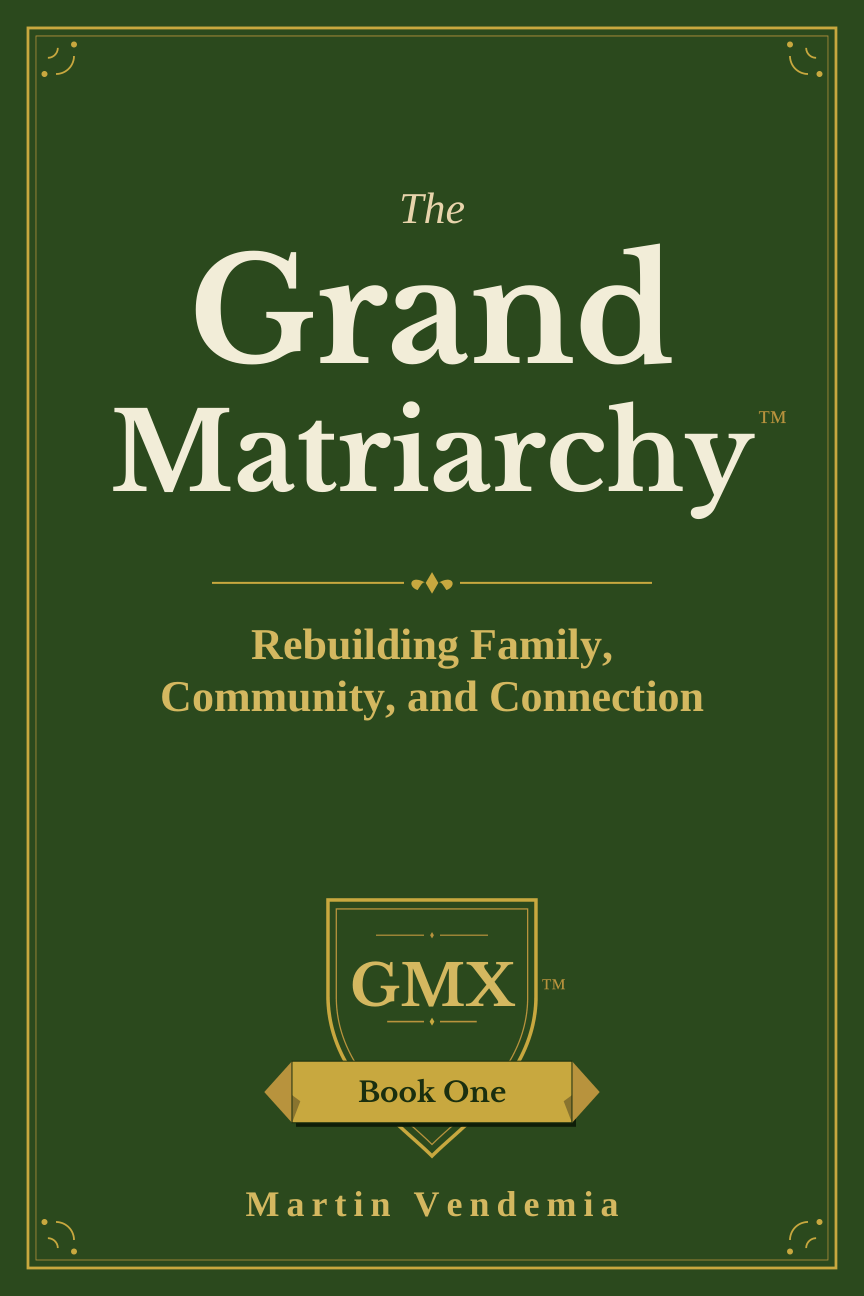
Book One of Five
The Grand Matriarchy
Rebuilding Family, Community, and Connection
by Martin Vendemia · An Inner Group Media series
The grandmother-centered family is not a cultural tradition. It is an evolutionary adaptation — a pattern of cooperation two billion years old — and the modern West quietly let it dissolve.
Also available at other retailers · Paperback & eBook
About the book
Evolutionary biologists have established that the human grandmother’s long post-reproductive lifespan is not a medical accident. It is an adaptation. The species survived because grandmothers who lived past childbearing improved the survival of their grandchildren. This pattern appears across life: killer whale pods follow elder matriarchs to food in hard years, elephant herds rely on grandmother memory during drought, and trees share resources through underground networks centered on the oldest members.
In much of the world, human grandmothers still perform this function. In the Philippines, Colombia, Nigeria, and across Asia, Africa, and Latin America, the grandmother-centered family is not a memory. It is Tuesday.
In the modern West, that system has quietly dissolved. A new mother alone at 3 AM with no one to call. A marriage cracking under the weight of what used to take a network. Half of all American adults reporting measurable loneliness. A care economy costing billions to replace what grandmothers did for free and did better. Fertility rates falling below replacement because the conditions for raising children without a network have become nearly impossible.
These are not separate problems. They are one system failure: the breakup of the grandmother-centered family, unplanned and unreplaced. The Grand Matriarchy names what was lost. It shows where it still thrives. It traces the evolutionary biology underneath it. And it offers a practical blueprint — five design principles — for rebuilding the grandmother function on purpose, in modern conditions, for anyone willing to build it.